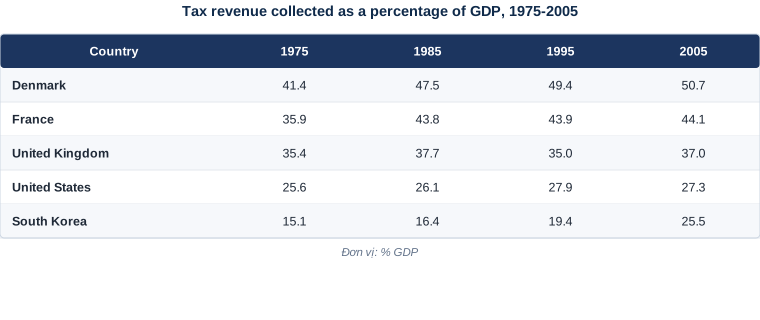
Table — Tax collected as a percentage of GDP in five countries, 1975-2005
📄 Bài mẫu band 8–9
| Introduction | Paraphrase: mức thuế thu được tính theo % GDP ở 5 quốc gia, 4 mốc từ 1975 đến 2005. |
| Overview | Overall: Đan Mạch luôn thu thuế cao nhất còn Hàn Quốc thấp nhất, nhưng chính Hàn Quốc mới là nước tăng nhanh nhất và thu hẹp khoảng cách. Không số liệu. |
| Body 1 | Đan Mạch 41,4% → 50,7% (duy nhất vượt mốc 50%); Pháp 35,9% → 44,1%, phần lớn mức tăng rơi vào thập niên 1975-1985. |
| Body 2 | Anh dao động 35,0-37,7%; Mỹ 25,6% → 27,3% gần như đứng yên; Hàn Quốc 15,1% → 25,5%, tăng hơn 10 điểm. |
The table shows how much tax was collected as a proportion of national income in five countries at four points between 1975 and 2005.
Overall, the tax burden was consistently heaviest in Denmark and lightest in South Korea. Taxation rose in every country over the thirty-year period, but the increase was far steeper in Korea than anywhere else, so the gap between the two extremes narrowed.
Denmark and France formed the high-tax group. The Danish figure began at 41.4% of GDP and climbed by more than nine percentage points to 50.7% in 2005, the only country in the table ever to exceed the halfway mark. France followed the same direction, from 35.9% to 44.1%, although almost all of its increase occurred in the first decade, after which the figure barely shifted.
The other three countries collected considerably less. Britain fluctuated within a narrow range, rising to 37.7% in 1985, falling back to 35.0% in 1995 and recovering to 37.0%, leaving it almost where it started. American taxation remained broadly stable throughout, between 25.6% and 27.9%. South Korea, by contrast, saw taxes climb from just 15.1% to 25.5%, closing the gap on the United States to less than two percentage points.
| the tax burden | gánh nặng thuế |
| climbed by | tăng thêm |
| exceed the halfway mark | vượt mốc một nửa |
| barely shifted | gần như không dịch chuyển |
| fluctuated within a narrow range | dao động trong biên độ hẹp |
| remained broadly stable | nhìn chung giữ ổn định |
| closing the gap | thu hẹp khoảng cách |