Process — How waste paper is recycled into new paper
📄 Bài mẫu band 8–9
| Introduction | Paraphrase: sơ đồ mô tả quy trình tái chế giấy đã dùng thành giấy mới. |
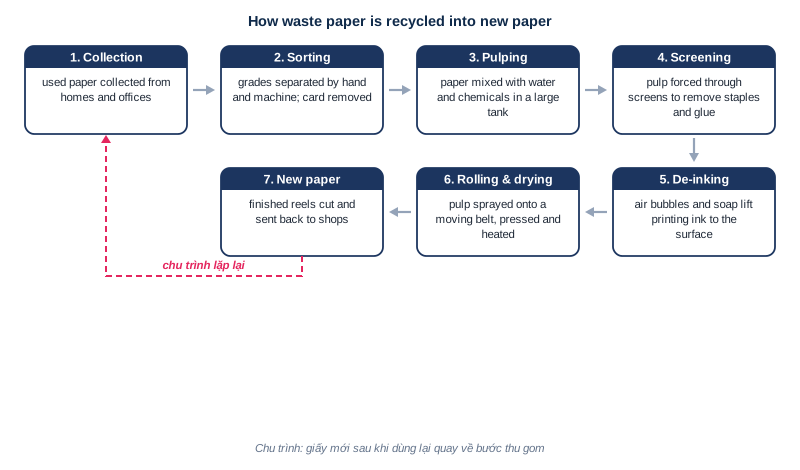
| Overview | Bảy giai đoạn, và điểm quan trọng nhất: đây là chu trình tuần hoàn — giấy mới sau khi dùng lại quay về đầu quy trình. Không chi tiết từng bước. |
| Body 1 — làm ra bột giấy sạch | Thu gom từ nhà và cơ quan → phân loại theo loại giấy, bỏ bìa → nghiền với nước và hoá chất → sàng bỏ ghim kẹp và keo → tẩy mực bằng bọt khí và xà phòng. |
| Body 2 — làm ra giấy mới | Bột giấy phun lên băng tải chạy, ép và sấy nóng → cắt thành cuộn → đưa về cửa hàng, dùng xong lại vào bước thu gom. |
The diagram illustrates the sequence of stages by which paper that has already been used is turned back into usable paper.
Overall, the procedure consists of seven distinct stages, beginning with collection and ending with finished reels of paper. What is most notable is that the process is cyclical rather than linear: once the new paper has itself been used, it re-enters the sequence at the first stage.
In the opening phase, waste paper is collected from households and offices, after which the different grades are separated by hand and by machine and any card is taken out. The sorted paper is then pulped, that is to say mixed with water and chemicals in a large tank until it breaks down. This pulp is forced through a series of screens so that staples and glue can be removed, before printing ink is lifted to the surface by air bubbles and soap.
In the second phase the clean pulp is converted back into sheets. It is sprayed onto a moving belt, where it is pressed and heated until it dries out. The paper produced in this way is finally cut into reels and returned to shops for sale, at which point the loop begins again.
| cyclical rather than linear | tuần hoàn chứ không phải một chiều |
| re-enters | quay lại vào (quy trình) |
| are separated | được phân loại |
| mixed with | được trộn với |
| is forced through | bị đẩy qua |
| is pressed and heated | được ép và sấy nóng |
| loop begins again | vòng lặp bắt đầu lại |