Process — The production of olive oil
📄 Bài mẫu band 8–9
| Introduction | Paraphrase: sơ đồ mô tả quy trình sản xuất dầu ô liu. |
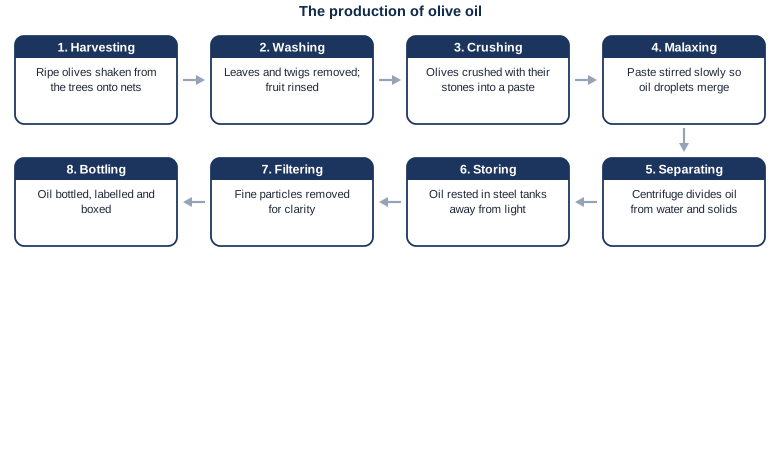
| Overview | Overall: quy trình gồm tám công đoạn thẳng một chiều, đi từ quả ô liu trên cây tới chai dầu thành phẩm, và hoàn toàn dựa vào các thao tác cơ học. |
| Body 1 | Bước 1-4: rung cây cho quả rơi xuống lưới → rửa, loại lá cành → nghiền cả hạt thành hỗn hợp nhão → đảo trộn chậm cho các giọt dầu kết lại. |
| Body 2 | Bước 5-8: máy ly tâm tách dầu khỏi nước và bã → ủ trong bồn thép tránh ánh sáng → lọc bỏ cặn mịn → đóng chai, dán nhãn. |
The diagram illustrates the sequence of stages by which olives are turned into bottled olive oil.
Overall, the process is linear and consists of eight stages, beginning with the harvesting of the fruit and ending with bottling for sale. Notably, the entire operation is mechanical, relying on crushing, stirring and spinning rather than on heat or chemicals.
At the first stage, ripe olives are shaken from the trees onto nets spread on the ground, after which they are washed and any leaves and twigs are removed. The clean fruit is crushed into a paste, stones included, and this paste is then stirred slowly in a process known as malaxing, which allows the tiny droplets of oil to coalesce into larger ones.
The oil is then separated from the paste in a centrifuge, which spins the mixture so that the water and solid residue are thrown out. The oil that remains is left to settle in steel tanks, protected from light, before being filtered to remove any fine particles that would cloud it. In the final stage the clear oil is bottled, labelled and boxed, ready for sale.
| are shaken from | được rung khỏi (cây) |
| is crushed into a paste | được nghiền thành hỗn hợp nhão |
| coalesce | kết dính lại với nhau |
| a centrifuge | máy ly tâm |
| is left to settle | được để lắng |
| ready for sale | sẵn sàng bán ra |