Process — The natural water cycle
📄 Bài mẫu band 8–9
| Introduction | Paraphrase: sơ đồ vòng tuần hoàn liên tục của nước giữa biển, khí quyển và đất liền. |
| Overview | Overall: một vòng kín không có điểm bắt đầu — nước biển bốc hơi thành mây, mưa rơi xuống vùng cao, rồi theo sông và mạch ngầm quay về biển; cùng một lượng nước luân chuyển mãi. |
| Body 1 | Đi lên: mặt trời làm nước biển bốc hơi → hơi nước gặp lạnh ngưng tụ thành mây → gió đẩy mây vào đất liền. |
| Body 2 | Đi xuống: mưa và tuyết rơi trên núi → nước theo sông chảy tràn về biển; một phần ngấm xuống thành nước ngầm — cả hai đường đều khép lại vòng tuần hoàn. |
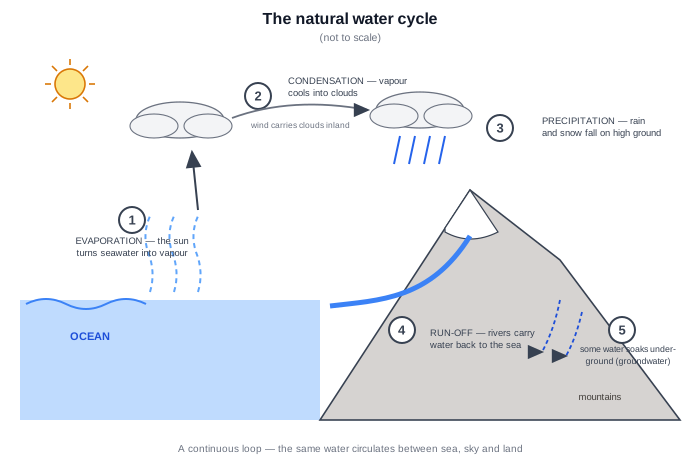
The diagram shows how water moves in a continuous cycle between the ocean, the atmosphere and the land.
Overall, the cycle has no beginning and no end: water that evaporates from the sea eventually returns to it, either over land as rivers or beneath it as groundwater, and the same water circulates indefinitely.
Taking the ocean as a starting point, heat from the sun causes evaporation, drawing water vapour up from the sea surface. As this vapour rises and cools, condensation occurs and clouds form. The wind then carries the clouds inland, towards higher ground.
Over the mountains the water returns to earth as precipitation — rain and, on the peaks, snow. From here it makes its way back to the sea by two routes. Most of it collects into streams and rivers, whose run-off carries it across the land and back to the ocean. The rest soaks into the ground, moving slowly through the soil and rock as groundwater until it, too, rejoins the sea — at which point the sun lifts it into the air once again.
| no beginning and no end | không đầu không cuối |
| same water circulates indefinitely | cùng lượng nước luân chuyển mãi |
| evaporation | sự bốc hơi |
| condensation | sự ngưng tụ |
| carries the clouds inland | đưa mây vào đất liền |
| precipitation | giáng thuỷ (mưa/tuyết) |
| run-off | dòng chảy tràn |
| soaks into the ground | ngấm xuống đất |
| groundwater | nước ngầm |