Process — How salt is produced from seawater
📄 Bài mẫu band 8–9
| Introduction | Paraphrase: sơ đồ cách sản xuất muối từ nước biển bằng phương pháp bay hơi. |
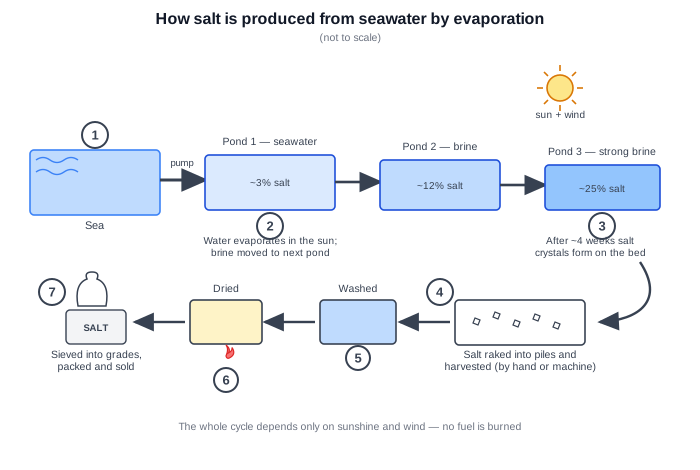
| Overview | Overall: 7 bước; nước biển được dẫn qua chuỗi ao phơi để nắng gió cô đặc dần từ ~3% lên ~25% muối, sau đó thu hoạch, rửa, sấy và đóng gói; toàn bộ giai đoạn cô đặc không dùng nhiên liệu. |
| Body 1 | Cô đặc: bơm nước biển vào ao 1 (~3% muối) → bay hơi, chuyển sang ao 2 thành nước ót ~12% → ao 3 ~25%; sau ~4 tuần muối kết tinh trên đáy ao. |
| Body 2 | Thu hoạch & hoàn thiện: cào muối thành đống, thu bằng tay hoặc máy → rửa sạch → sấy khô → sàng phân loại, đóng gói bán ra thị trường. |
The diagram shows the seven stages by which salt is extracted from seawater using natural evaporation.
Overall, the key feature of the process is that it relies almost entirely on sunshine and wind rather than fuel: seawater is moved through a chain of shallow ponds, becoming progressively saltier until crystals form and can be harvested.
The process starts when seawater, which contains roughly three per cent salt, is pumped from the sea into the first evaporation pond. As the sun and wind evaporate the water, the brine left behind becomes more concentrated, and it is transferred to a second pond at a strength of about twelve per cent. In the third pond the concentration reaches approximately twenty-five per cent, and after around four weeks a layer of salt crystals forms on the bed of the pond.
In the harvesting stage, the salt is raked into piles and collected either by hand or by machine. It is then washed to remove impurities and dried over gentle heat — the only point in the process where fuel is used. Finally, the salt is sieved into different grades before being packed and dispatched for sale.
| evaporation pond | ao phơi bay hơi |
| brine | nước ót/nước muối đậm đặc |
| progressively saltier | mặn dần lên |
| concentration | nồng độ |
| crystals form | tinh thể kết tinh |
| raked into piles | được cào thành đống |
| impurities | tạp chất |
| sieved into different grades | được sàng phân loại |