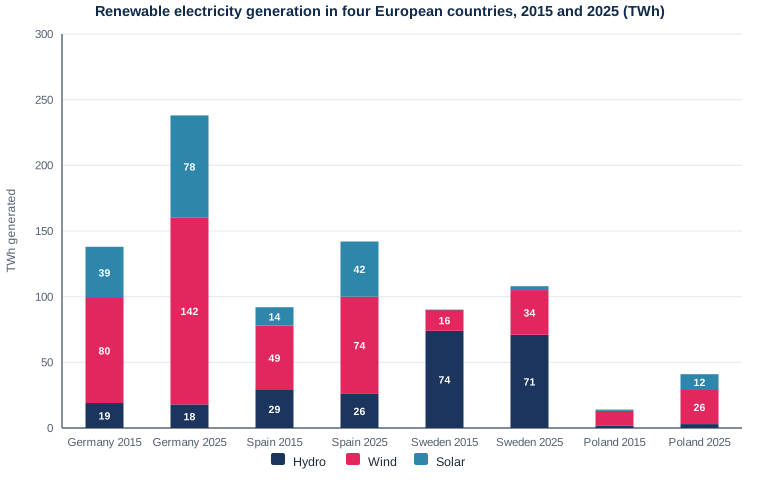
Bar chart — Renewable electricity generation in four European countries, 2015 and 2025
📄 Bài mẫu band 8–9
| Introduction | Paraphrase: sản lượng điện tái tạo từ 3 nguồn ở 4 nước châu Âu, 2015 và 2025, đơn vị TWh. |
| Overview | Overall: cả bốn nước đều tăng sản lượng, và gần như toàn bộ mức tăng đến từ điện gió và mặt trời trong khi thuỷ điện đứng yên. Không số liệu. |
| Body 1 | Đức 138 → 238 TWh (lớn nhất; gió 80 → 142, mặt trời 39 → 78); Tây Ban Nha 92 → 142 TWh, mặt trời gấp ba (14 → 42). |
| Body 2 | Thuỵ Điển 90 → 108 TWh, thuỷ điện 74 → 71 gần như không đổi; Ba Lan 14 → 41 TWh, tăng gần gấp ba từ nền rất thấp. |
The stacked bar chart compares how much electricity, in terawatt hours, four European countries generated from hydro, wind and solar power in 2015 and 2025.
Overall, renewable output rose in all four countries over the decade, and almost the entire increase was driven by wind and solar power. Hydroelectricity remained flat everywhere, and Germany produced far more renewable electricity than any other country at both dates.
German output grew from 138 to 238 TWh, the largest absolute increase in the chart. Wind accounted for the lion's share, rising from 80 to 142 TWh, while solar generation doubled from 39 to 78 TWh. Spain followed a similar pattern at a smaller scale, climbing from 92 to 142 TWh, with solar power tripling from 14 to 42 TWh — the fastest growth of any single source in the two countries.
The remaining two countries were different in character. Sweden depended overwhelmingly on hydro power, which barely moved from 74 to 71 TWh, so its total rose only modestly, from 90 to 108 TWh. Poland started from a low base of 14 TWh but nearly tripled its output to 41 TWh, the steepest rise in percentage terms.
| was driven by | được dẫn dắt bởi |
| remained flat | giữ nguyên, đi ngang |
| the largest absolute increase | mức tăng tuyệt đối lớn nhất |
| accounted for the lion's share | chiếm phần lớn nhất |
| barely moved | gần như không nhúc nhích |
| from a low base | từ một mức nền thấp |
| in percentage terms | xét theo tỷ lệ phần trăm |