Band 8.5 — Process: The Life Cycle of the Honeybee
📄 Bài mẫu band 8.5
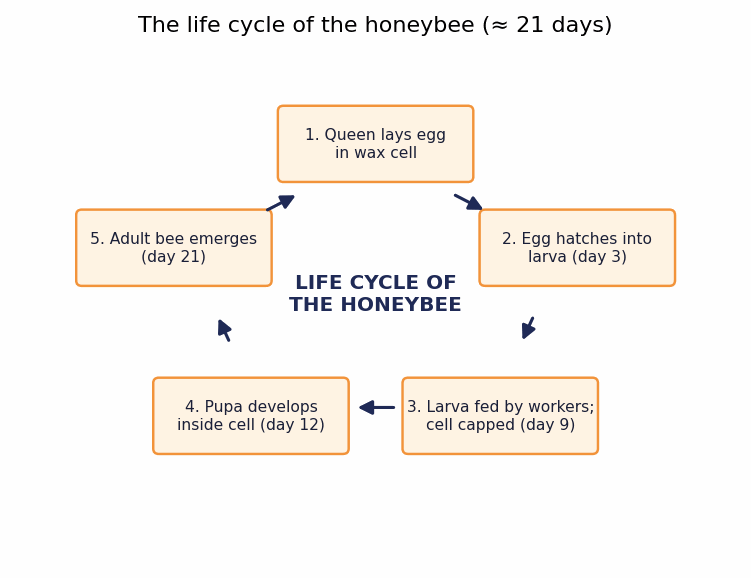
The diagram illustrates the successive stages in the life cycle of the honeybee, from the laying of an egg to the emergence of an adult.
Overall, the cycle comprises five main stages and takes roughly three weeks to complete. Its two most notable features are that the whole sequence is continuous and repeating, and that every stage of development unfolds inside a single wax cell of the honeycomb.
The cycle begins when the queen bee lays an egg within a cell. After approximately three days, this egg hatches into a larva, a small white grub which is fed constantly by worker bees. By around the ninth day, the larva has grown considerably, whereupon the workers seal the cell with a wax cap.
Within this sealed cell, the insect enters the pupa stage at about the twelfth day, during which its body is gradually transformed into that of an adult. In the final stage, roughly 21 days after the egg was laid, the mature bee chews its way out and emerges. This new adult will in time lay eggs of its own, and thus the entire cycle begins again.