Band 8.5 — Pie Charts: How Adults Spent Their Free Time (2000 vs 2020)
📄 Bài mẫu band 8.5
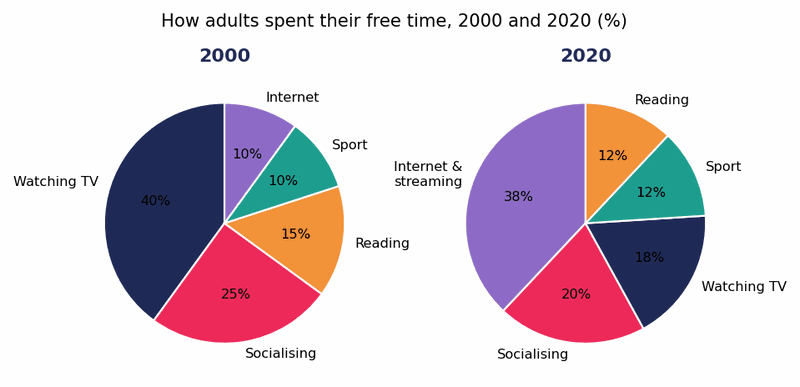
The two pie charts compare how adults allocated their leisure time in 2000 and 2020.
Overall, television, which absorbed by far the largest share of free time in 2000, was overtaken by online activity two decades later, while the proportions devoted to sport and socialising altered comparatively little.
In 2000, watching television was the leading pastime, accounting for 40% of all leisure time—twice the share of any other activity apart from socialising, which made up a quarter. Reading occupied a further 15%, whereas sport and internet use represented the smallest slices, at just a tenth each.
By 2020, however, the distribution had shifted markedly. Time spent online, at 38%, had almost quadrupled to become the dominant category, while television's share more than halved to 18%. Socialising slipped moderately from 25% to 20%, whereas sport edged up to 12%. Reading, meanwhile, fell only marginally to 12%, meaning that the two traditional pastimes—books and television—together accounted for under a third of leisure time, against more than half in 2000.