Band 8.0 — Table: Population Indicators in Four Countries
📄 Bài mẫu band 8.0
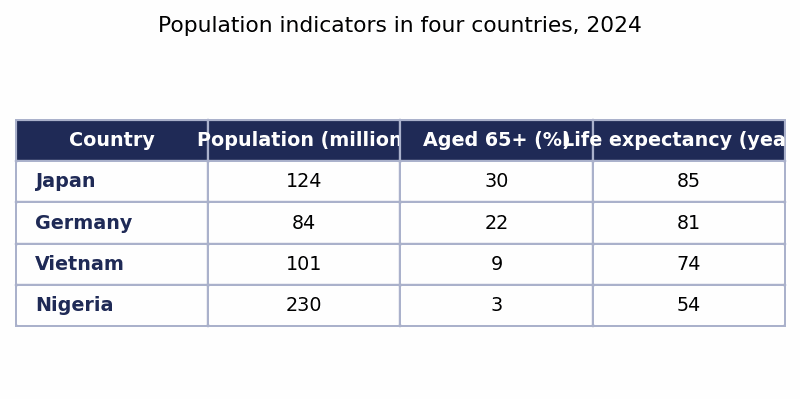
The table compares four countries in 2024 in terms of their total population, the proportion of citizens aged 65 and over, and average life expectancy.
Overall, the two developed nations are characterised by markedly older populations and considerably longer lifespans than their developing counterparts, whereas population size follows no such divide, being dominated instead by a single developing country.
Japan and Germany typify wealthy, ageing societies. Three in ten Japanese citizens are aged 65 or above, a share not quite matched by Germany, where the figure stands at more than a fifth. Life expectancy reaches 85 and 81 years respectively, the highest in the table.
The developing nations present almost the reverse profile. Nigeria, whose population of 230 million is nearly double Japan's 124 million, records the youngest citizenry, with a mere 3% having reached 65 and average life expectancy standing at just 54 years—fully three decades shorter than Japan's. Vietnam occupies an intermediate position: although its population of 101 million remains comparatively young, with 9% aged over 65, its life expectancy of 74 years lies far closer to the European figures than to Nigeria's.