Band 8.0 — Table: Average Salary and Working Hours in Five Countries
📄 Bài mẫu band 8.0
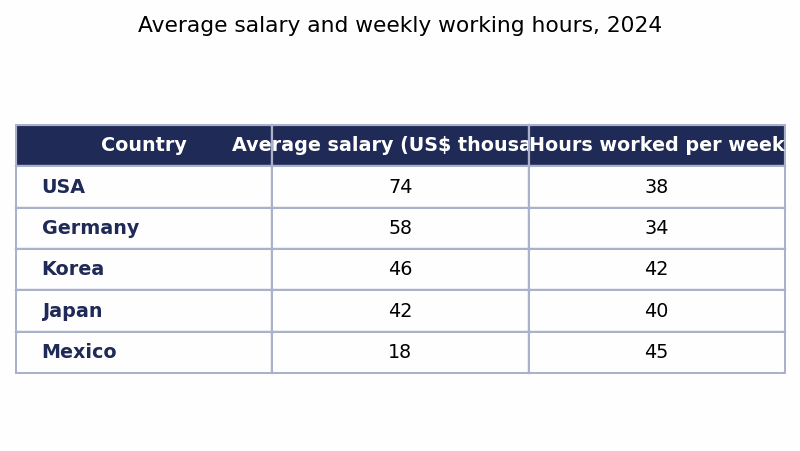
The table compares five countries in 2024 in terms of average annual pay, expressed in thousands of US dollars, and the length of the average working week.
Overall, a broadly inverse relationship emerges between the two measures: the highest-earning nations tend to work the shortest weeks, while the lowest-paid workforce puts in the longest hours.
The USA heads the salary ranking at $74,000 a year, followed by Germany on $58,000. Yet these two countries also record the shortest working weeks, at 38 and 34 hours respectively, so that German employees earn more than three times the Mexican average while spending eleven fewer hours at work each week.
At the opposite extreme, Mexico combines the lowest pay of all, $18,000, with the longest week, 45 hours. The two East Asian countries fall between these poles. Korean workers earn $46,000 for a 42-hour week, whereas their Japanese counterparts take home $42,000 for 40 hours—salaries that remain well below the Western pair despite working weeks that are five or more hours longer.