Band 8.0 — Pie Chart: Water Use by Sector
📄 Bài mẫu band 8.0
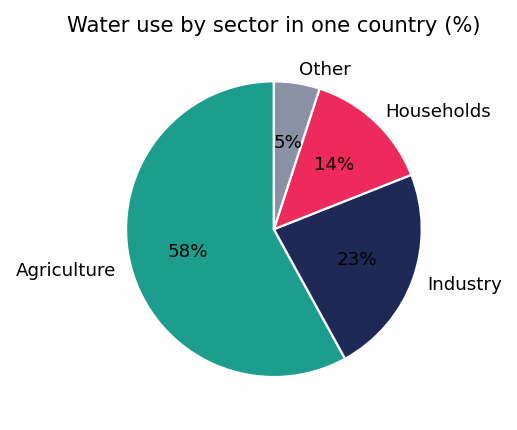
The pie chart illustrates how water consumption is distributed among four sectors in a particular country.
Overall, agriculture is by far the heaviest user of the nation's water, consuming more than the other three sectors combined, whereas domestic use—despite its prominence in everyday life—accounts for only a modest proportion.
Farming clearly dominates the picture, accounting for 58% of all water used—well over half the total and roughly two and a half times the industrial figure. Industry ranks as the second-largest consumer at 23%, which means that production activities of one kind or another absorb just over four-fifths of the country's water between them.
The remaining fifth is shared between households and miscellaneous purposes. Domestic use makes up 14% of consumption—a surprisingly small fraction, given that public debate about conservation tends to centre on household habits—while the final 5% is devoted to other minor uses. These figures suggest that meaningful water savings depend far more on agricultural efficiency than on curbing domestic consumption.