Band 7.5 — Process: Manufacturing Bricks for the Building Industry
📄 Bài mẫu band 7.5
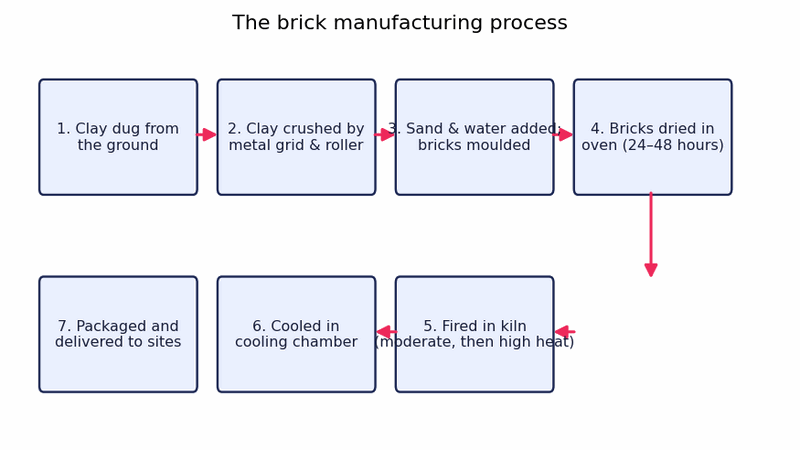
The diagram illustrates the stages by which bricks are manufactured for use in the building industry.
Overall, this is a linear, man-made process made up of seven stages, beginning with the extraction of raw clay and ending with the finished bricks being delivered to construction sites. A prolonged period of heat treatment forms the central part of the sequence.
At the first stage, clay is dug from the ground, typically by a mechanical digger. It is then passed through a metal grid and crushed by a roller so that it breaks into fine particles. Following this, sand and water are added, and the resulting mixture is pressed into moulds to form individual bricks.
The moulded bricks next undergo a lengthy heating sequence. They are first placed in a drying oven for between 24 and 48 hours, after which they are fired in a kiln, initially at a moderate temperature and then at a high one. Once fired, the bricks are transferred to a cooling chamber, and in the final stage they are packaged and delivered to building sites, ready for use.